
A Kiwi Twist for Robotics: AUT Research to Develop Specialised AI Software for Real-World Deployment
The idea of humanoid robots and robotic dogs roaming our shopping centres might sound like something out of a sci-fi movie, but the technology is close to becoming a reality. Advanced robots are incredibly capable pieces of hardware, but to truly be useful in Aotearoa New Zealand, they need a "brain" that understands our local environment and culture.
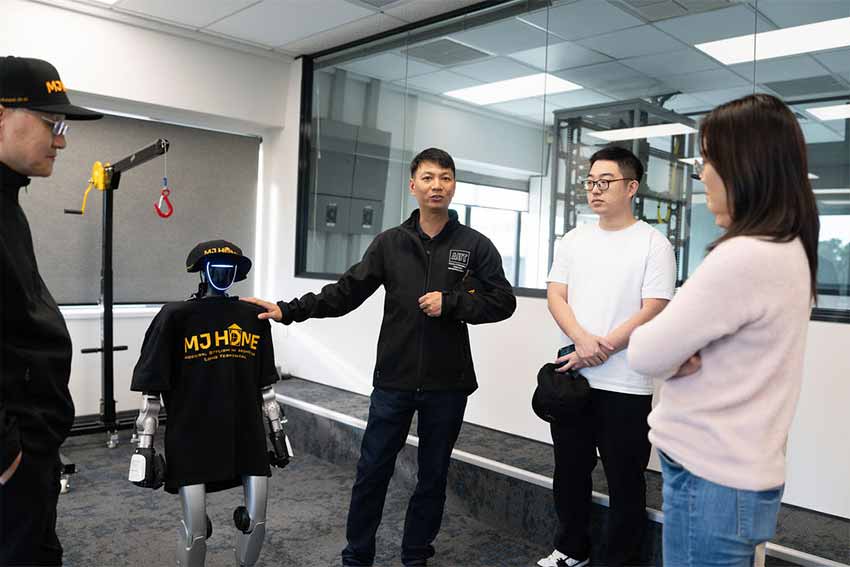
This is the driving force behind an exciting new collaboration between AUT and modern living specialists, MJ Home. Together, they are developing a specialised AI software suite to adapt cutting-edge humanoid and quadruped (dog-like) robots for real-world deployment in New Zealand retail and security settings.
Smarter, safer, and culturally aware
Professor Minh Nguyen from AUT’s Department of Computer and Information Sciences leads the development of a bespoke AI software suite for Unitree’s G1 humanoid and Go2 quadruped (dog-like) robots.
While MJ Home supplies the sophisticated hardware and handles physical site deployment, Professor Nguyen’s team is building the software "brains" that will allow the robots to see, hear, and interact in a uniquely New Zealand context.
A major focus of the software is cultural localisation. The AI will enable the robots to greet customers using culturally appropriate expressions in te reo Māori. To ensure this is designed respectfully and inclusively, the AUT team is working closely with cultural advisors, including Dr. Hazel Abraham ( Ngāti Awa, Ngāti Tūwharetoa, Ngāti Rangitihi, Te Whakatōhea, and Ngāi Tūhoe).
“Global AI platforms are amazing, but they lack the cultural protocols and specific scenarios needed for New Zealand,” explains Professor Minh Nguyen. “We are taking world-class robotic platforms and equipping them with the interactive capabilities they need to truly belong in our communities, whether that’s welcoming a shopper or navigating complex situations.”
Tackling a billion-dollar problem
Beyond customer engagement, the AI suite is tackling serious local issues. Retail crime costs New Zealand over $1.5 billion annually, and many sectors face severe staff shortages for late-night or hazardous shifts.
Equipped with advanced object and person-detection technology, the vision is that the newly programmed robots will act as a powerful deterrent for shoplifting. They can also step in to assist with unattractive or dangerous tasks, such as night-time security patrols, keeping human workers out of harm's way.
From the lab to the shop floor
This 12-month digital transformation is being propelled by a $40,000 Tīmatanga Initiate Grant from the AUT Innovation Fund, which supports promising early-stage research with real-world collaborators.
The grant allows AUT to put a dedicated team on the project, including a PhD student focused on AI development and an MBA intern mapping out market research, to move the technology out of the lab and into pilot deployments in 2025.
For the School of Engineering, Computer and Mathematical Sciences (ECMS), the partnership exemplifies the value of applied technology.
“It is fantastic to see our academic expertise in artificial intelligence translating directly into commercial and community impact,” says Professor Tek Lie, Head of School for ECMS. “This collaboration with MJ Home, supported by the Tīmatanga Grant, perfectly illustrates how AUT researchers are stepping up to solve complex, real-world challenges while keeping Aotearoa’s unique cultural context at the forefront.”
By blending cutting-edge data science with a deep respect for local culture, this partnership is proving that the future of robotics doesn't have to be a one-size-fits-all import. Instead, it can be tailor-made for Aotearoa.