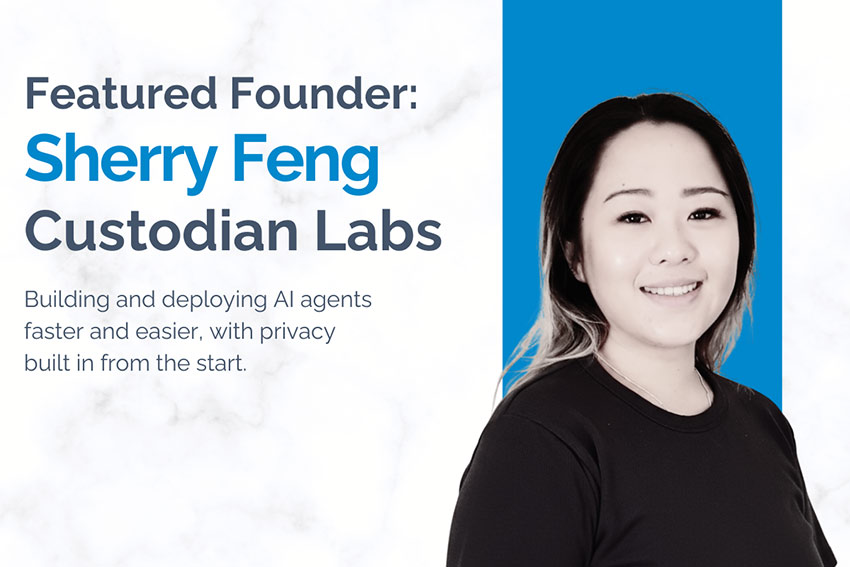
Featured Founder: Sherry Feng
AI promises to make our lives easier. But as organisations race to embrace its potential, what happens when using it creates a whole new set of problems?
For an everyday question, sharing information with an external AI model might carry little consequence. But when customer records, financial information, medical details or other sensitive data are involved, the stakes are considerably higher. Sherry Feng saw these challenges firsthand as an AI research scientist, while her PhD in Computer Science at AUT helped lay the foundations for a solution.
The result evolved into AUT spinout Custodian Labs, created to make building and deploying AI agents faster and easier, with privacy built in from the start.
Making AI more accessible
Building an AI agent isn’t as simple as choosing a model and putting it to work. The servers, databases and infrastructure behind it can take specialist engineers months to build and manage, putting AI out of reach for many smaller teams.
Custodian Labs takes care of much of that infrastructure behind the scenes, giving developers the tools they need to build, secure and deploy AI agents in just a few lines of code.
“Think of us as the layer that takes someone from an idea to a live AI agent, without needing a whole engineering team behind them,” Sherry explains.
But making AI easier to build is only half the challenge. Organisations also need to trust it with their data.
Privacy without sacrificing performance
Sending sensitive information to an external AI model can mean losing control over where that data goes. Removing it protects privacy but can also remove the context that makes AI useful.
Sherry’s answer for Custodian Labs was the Guardian Layer, a protective layer between an organisation’s data and the AI model. It detects and masks sensitive information before it reaches the AI, keeping the context intact while the real data stays protected. “You get the full power of AI without ever handing over the sensitive data,” says Sherry.
It’s a key point of difference. Rather than being tied to a single AI model, Custodian Labs allows developers to work across different models with privacy built in from the start. Organisations have already approached the team about licensing the Guardian Layer on its own, an exciting sign of its wider potential.
Building AI we can trust
With support from AUT Ventures, Custodian Labs is already gaining commercial traction and showing there’s real demand for the technology. Since launching its website just over a month ago, the venture has welcomed its first paying developers and customers, secured backing from an angel investor, and signed a fintech customer in New York.
As Sherry’s PhD supervisor, Professor Edmund Lai, Director of AUT AI Research Centre, School of Engineering, Computer and Mathematical Sciences, says:
“Sherry has a rare ability to understand both the technical possibilities of AI and the practical challenges organisations face when trying to adopt it. This is reflected in the solution that Custodian Labs provides. It takes a complex infrastructure and privacy problem and turns it into something genuinely useful. Seeing that translate into early commercial interest is incredibly exciting.”
With AI becoming an unavoidable part of how we work and function as a society, Sherry believes building AI we can trust is more important than ever. For Custodian Labs, that leads towards one simple vision: “A world where AI can be trusted with anything.”