
Shifting Gears: AUT Researcher Using AI to Revolutionise Mechanical Engineering
Gears are the unsung heroes of modern industry. From the transmission in your car to the engines of commercial airplanes and the heavy machinery used in manufacturing, these vital components keep our world moving. But despite massive leaps in advanced manufacturing, like industrial 3D printing, the way we actually design these gears, and particularly systems of multiple gears, has hit an innovation roadblock.
Currently, the mechanical engineering industry relies on highly sophisticated software to test and refine gear system designs. However, these state-of-the-art tools share a fundamental limitation: they are evaluative, not creative. They are great at predicting the performance of a gear system that a human engineer has already dreamed up, but they can’t generate a completely new concept from scratch… yet!
An exciting new project from AUT is stepping in to close this innovation gap, using Artificial Intelligence to completely reinvent the process of gear system design.
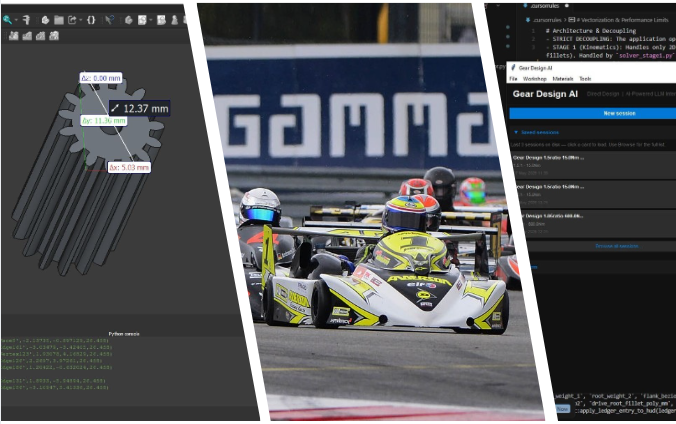
Designing without limits
The concept for this project originated with Tim Hart of Compact Motorsport, an industry leader who has spent the past decade researching and commercialising "direct gear design" methodologies. Looking to take this know-how to the next level, Hart partnered with AUT's Associate Professor in Mechanical Engineering Michael Gschwendtner and Master’s student Andre Paynter to build a tool that could unlock truly novel gear systems.
Instead of an engineer manually drawing a gear and testing if it works, they simply input their performance goals into the new desktop application. Paynter’s AI framework then takes over, using generative design algorithms to explore countless geometric possibilities and discover superior gear systems that humans might never have conceptualised.
Crucially, the AI is completely unconstrained by traditional manufacturing methods, meaning it can generate highly complex, optimised 3D gear geometries ready for immediate fabrication.
“For decades, gear design has been limited by what a human can conceptualise and what traditional machines can physically cut,” says Dr. Michael Gschwendtner. “By leveraging AI and generative design, we are completely decoupling the design process from those historical constraints. We’re giving engineers a tool that doesn't just test their ideas but actively discovers better ones.”
Investing in the research
To bring this ambitious software from theory to reality, the project is being backed by a $40,000 Tīmatanga Initiate Grant. Designed to accelerate promising AUT research, this Innovation Fund initiative will support the project over the next year to create a validated, user-friendly prototype.
The funding will help the team navigate complex technical challenges, ensuring the AI algorithms can consistently find optimal solutions and generate designs that are actually possible to reliably manufacture.
“This project represents a critical leap forward for mechanical design,” says Professor Robert Niven, the Head of Department – Mechanical Engineering. “Associate Professor Gschwendtner and his team's research is perfectly aligned with the future of advanced manufacturing. The Tīmatanga Grant provides the essential support needed to build a working prototype, helping to translate this complex academic research and deep industry knowledge into a highly valuable commercial tool.”
A blueprint for the future of manufacturing
The commercial potential of this AI framework is immense. Pathway to market is already being established through Compact Motorsport's manufacturing and marketing base.
By empowering engineers to create superior, highly optimised mechanical systems, the software offers a tangible competitive advantage for industries reliant on high-performance machinery. Whether it's creating lighter parts for the aerospace sector, more efficient transmissions for automotive manufacturers, or more durable components for industrial machinery, this Kiwi collaboration is preparing to shift the global manufacturing industry into a higher gear